Showing posts with label dad. Show all posts

07 October 2013

an introvert in the woods


Over the weekend, I took a little retreat from my normal life, or as I like to refer to it: I ran away from home for a night. It's so much more satisfying, by the way, to run away from home when you're old enough to drive.

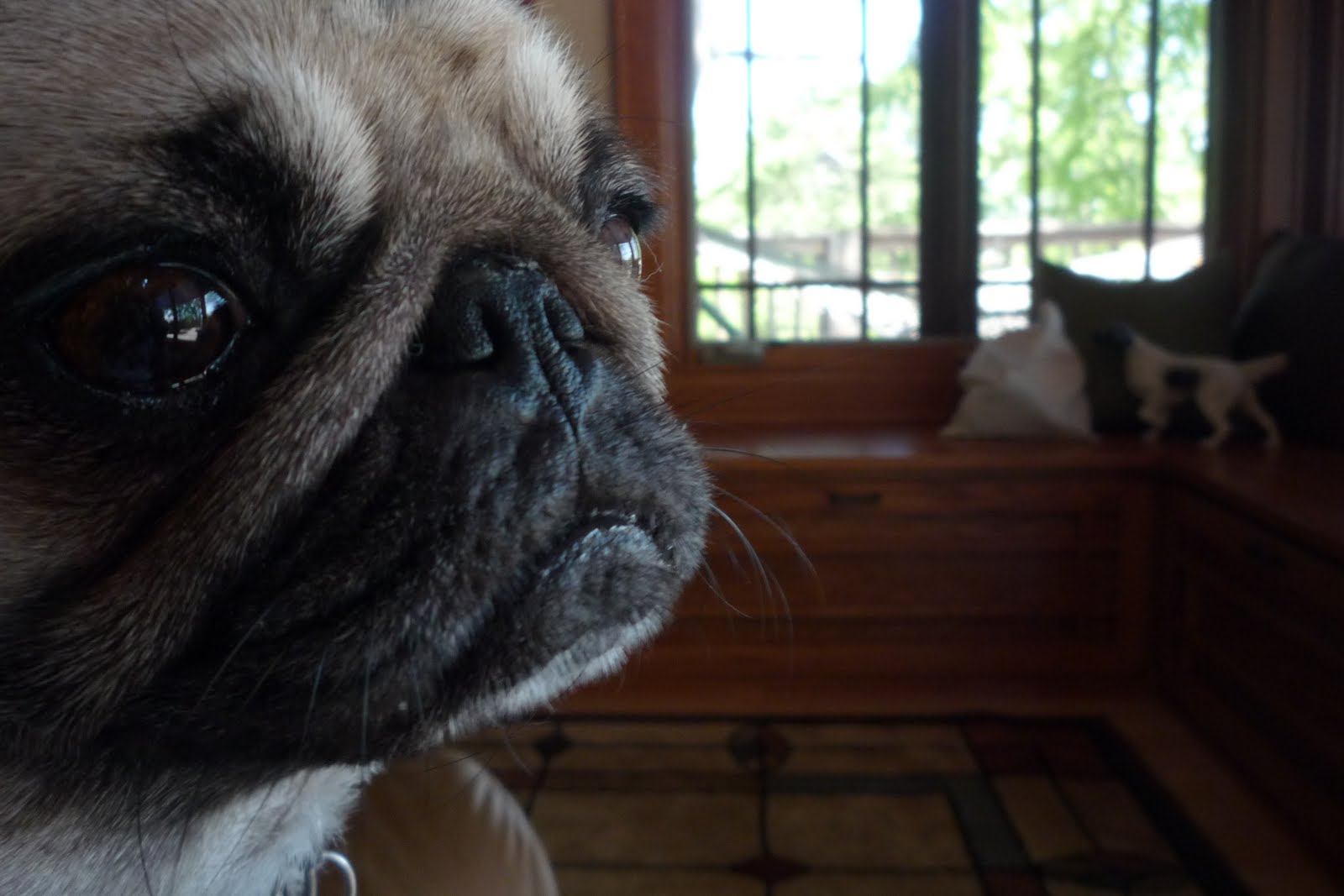
I brought Miss Daisy the Pug with me to go camping at the Richard Bong Recreation Area near Kenosha, Wisconsin. I picked that because 1) it was the first thing that turned up with I googled "camping near Kenosha" that wasn't an RV store, 2) it was just an hour and 20 minutes away, and 3) I could reserve a campsite with just a few days' notice. All these campgrounds in Illinois, you have to reserve a week in advance, or of course, you can risk it and just show up.

Risking it is not in my genetic make-up, and if I'm going to drive an hour+ after packing a car of camping supplies, I would like to be darn sure that will be a campsite with my name on it at the other end.

So to Wisconsin I went, where they allow for my level of spontaneity: you can make reservations with 3 days' notice and feel assured of your "spur-of-the-moment" planning.

It was such a good decision.

I've never done the solo camping thing, although I am well-equipped for it. By that I mean that I have all the stuff necessary, but I also mean that I have the personality necessary. I told a few people at work on Friday what I was doing, and I received mostly comments of awe that I would dare to do that.

"Won't you be scared?"

"But it's so dark!"

"Who will you talk to?"

"What if you have a problem?!?"

"Are you going to pretend to be Thoreau and come back with your journals to publish? Are you going to talk exclusively about living deliberately when you come back on Monday?"

But all I kept thinking—ever since I made the reservation—was, "I can feel my soul expanding with this possibility of being so far away from my normal life." {No offense to all the people in my normal life.}

My introvert self was very much made for solo camping trips, and thanks to my parents, who began outfitting me with camping equipment when I was still quite young, I have everything I need to run away from home and pitch a tent and cook over a grill and pump my own water out of a spigot that looks like it's been there since Laura Ingalls Wilder was alive.

I love camping for many reasons, and it's one of the continual joys of my life that my parents raised me on a foundation of outdoorsy-ness. {It's such a joy that I've even written about it before when I was flying over the desert on the way to Las Vegas.}

I love camping now because it reminds me of growing up, and I can't set foot in a campground without remembering the hundreds of other campgrounds I've been in {all blending into a generalized one, of course, with a mish-mash of red rocks, mountain streams, and tall trees that always smell sweet in the morning air}.

I think about how my sister and I used to spend hours (it seemed) riding the loops of various campgrounds on our bikes. We'd read for awhile, bike for awhile, volunteer to go get water, set up our own steeplechase course {hey, you see what sorts of activities you come up with when you are so far from humanity that you start to think it's normal to shower just once a week}.

And in the evenings, our whole family would sometimes take long bike rides around whatever national park or state park we were in before settling in to play Hearts or study the stars. {All those star lessons, and all I can pick out with any confidence is Orion, Cassiopeia, and the Big Dipper.}

So I love camping for that nostalgic reason—but I also love it because it pares you down to the essential. Everything—from boiling water to cooking breakfast—takes longer than you ever budget for in your regular life, and there's a quiet beauty in saying: I would like coffee, but it's going to be a little while. Delayed pleasure and all that.

Your day essentially becomes about the survival tasks, and so instead of running from activity to activity, you take your time and focus on where you are. I am scrambling eggs over a grill. I am boiling water to clean the skillet. I am doing the crossword while drinking coffee.

I think that's what I needed when I ran away from home: to be present where I am. There is nothing else in a campground to distract me, unlike at home where I could always be cleaning a bathroom or organizing recipes or re-doing my budget. There's always some task to be done, but in a campground, I cannot do any of that.

I cannot clean the bathroom; it's a pit toilet and the thought of cleaning that is something to avoid contemplating for very long.

I cannot do laundry; I wear the same clothes for several days.

I cannot see friends; they are over an hour away back home.

When I was camping, it was just me and my little pug surrounded by trees and a soft dampness to the air that helps you remember that life is more than running from one thing to the next.

And as a bonus, when camping alone with a pug, you get to see faces like this all the time—faces that say, "But I thought we lived inside!"

27 March 2013

5 things that prove I love Garrison Keillor


My love of Garrison Keillor has finally paid off, in the way only an English major raised on a steady intake of A Prairie Home Companion would consider a pay off:

As a promotion for his new CD, My Little Town, he's doing a "submit your favorite story about your little town" contest, and he picked this thing I wrote to publish on his site. {I'll tell you more about the thing in a minute.}


  Note several things:

  • I keep saying "he," as if Garrison is there coding the submission form. {You can see it for yourself and admire his handiwork. Such a renaissance man, he is.}
  • Or as if he's staying up past his bedtime reading submissions from people around the country who are trying to make their town sound like Lake Wobegon.
  • I mean, I realize that Garrison probably didn't actually read my poem, but I'm going to pretend. After years of listening to him him spin tales about a town that seemed so familiar and home-like to me, I'm going to pretend that he read about my little town—out loud, obviously, in that deep, nostalgia-creating voice of his—and thought to himself, 'Well, oh my, I'd like to go to this town this Kamiah girl is from. Maybe the next time I'm doing my show at Ravinia, I'll pop out to Glen Ellyn and visit her. We'd get along like gangbusters.' I just know he'd use the word gangbusters.

Yes, I'm going to pretend that my poem has now become one of Garrison Keillor's favorites.

In my mind, he's going to read it on that Writer's Almanac podcast of his someday {which I just wrote about yesterday. Garrison and I are already displaying best-friends-who-think-alike behavior}.

Please don't take my fantasy away from me, but give an NPR nerd her moment in the pale Minnesota sun that's shining down on Lake Wobegon right now.


A Little More about This Thing I Wrote

All you had to do was tell a story about your hometown, and I, in a rare moment of turning my back on Iowa, submitted a poem about Glen Ellyn that I wrote about two years ago. The carnival comes to town every year, and there is nothing like the smell of corndogs to put me in a poetry mood. {That's just the kind of statement Garrison would relate to.}

You can read the poem here on my blog.

Or, if you'd like to see it in its Prairie Home Companion glory, you can see it here. {You, sadly, have to scroll down to the bottom. I need to call Garry and get him to put my poem on the top.}

So, there you have it: Garrison Keillor is, I'm sure, going to visit Glen Ellyn soon in order to meet me. If he comes during the carnival, I would most definitely buy him a funnel cake.

The following list may help really convince him that he should come.


5 Things that Prove I Love Garrison Keillor

  1. I own this t-shirt:

    It is, for those of you who don't know {I scoff at you}, the shirt for the Professional Organization of English Majors, this group that Garrison made up and sometimes does sketches about. If it were real, you know I'd belong.

    If you're an English major and you'd like a shirt, too, you should order one from Garrison.
  2. I once met him—at Tanglewood. My family, we're kind of Garrison groupies, and we went out to western Massachusetts to see him do his show live one summer. Afterwards, we stood in line to meet him. When he heard my name, he said, "Kamiah. Kamiah. That sounds like a name that belongs in a limerick," which is not something I've ever had said to me before, nor is it the conversation I envisioned having with him, but that is all right.
  3. When I was in middle school, someone asked what I liked to listen to on the radio. I said, "A Prairie Home Companion," before I realized that I should've said, "Really awesome music that kids my age would know."

    That experience mirrors the time in elementary school when we were asked our favorite band, and I said, "Peter, Paul, and Mary."
  4. My parents go on the Prairie Home Companion cruises almost every summer. I realize this doesn't really prove why I love Garrison, but it clearly shows that it's in the blood.
  5. Someone once told me, "Your stories sound like something Garrison Keillor would tell. You're like a 30something girl version of him." I had just recently met the person, and I wanted to hug them. That is the 3rd best compliment I've ever received.


12 August 2012

homecoming in the red rocks


Today I became one of those people who take pictures out plane windows.

I've made the flight from Chicago to Las Vegas three times now in the past year {and by this time next month, I will have made it four times}, and every time, I've looked down at the red rocks and desert below me and thought: I know I must've been there.

My family spent most of our vacations camping out West, perhaps because it was as different a landscape as you could get from Iowa. My parents have given me many things, but every time I come back to Utah and the desert, I am grateful one more time for their gift of travel.

They made sure we saw the world beyond the cornfields, and now seeing the red rocks feels like a homecoming. On the plane today, it felt like the great, expansive landscape below me was welcoming me with open arms.

And so I had to take a picture. It's like seeing a friend you haven't seen in a long time: you want to document the moment when some part of you you didn't know was lonely suddenly felt full again.

The desert doesn't make me feel lonely so much as aware of my own smallness. Even looking at it from 35,000 feet—high above and through the scattered wisps of clouds—it makes you realize how you take up one speck of the world and how surrounding you are other little specks trying to make the most of where they are.

These are the kinds of thoughts the desert brings me. {I never think of it as me bringing anything to the desert.} I wanted to share it with someone, and so I turned to the girl sitting next to me on the United flight.

She was watching a subtitled British show on her iPad—subtitled into Chinese. At the moment I turned to her, Stonehenge was exploding in the show and she was laughing. I thought something might've been lost in translation and decided to leave my desert thoughts in my head.

And on my camera. I took a picture of my homecoming to the red rocks and wondered if my dad, looking at this picture, would be able to tell what I was flying over. His memory for our vacations—his memory for everything—always makes me jealous.

I wanted him on that plane with me so he could lean over and say, "Right there? We were camped there when you were 7 and your sister was 9. We spent the day hiking [fill in the name of a trail I can't remember] and then the night was so clear we decided to sleep under the stars."


10 July 2012

in which i eat a dime and have a grand adventure {part 3}


Part 3 of a story about the time I ate a dime while my family was on RAGBRAI.

Don't know what RAGBRAI is? You should probably read Part 2, which explains it.

Want to hear the beginning? You should probably read Part 1, which is, obviously, the beginning.

---------

It was late July, and my sister Oesa and I needed a purpose.

On RAGBRAI, everyone else in our family had a purpose: either bike 60ish miles a day through the cornfields, or drive the car to the next town and set up camp so that when the rest of the family got in town—hot, sweaty, unable to feel their legs—the tents were already up for them to lay down in after showering.

But since Oesa and I were only 5 and 3, there wasn't much expected of us. Oh, I'm sure we helped choose our campsite {proximity to a playground is worth 10 points on the Campsite Selection Scale}, and maybe we even helped pitch the tents. Perhaps my chubby toddler fingers were put to work grasping a chubby toddler hammer to drive the stakes in.

Mostly, though, Oesa and I were along for the ride. Literally, on some days; our mom would pull us in a buggy behind her bike.

Being a demanding and ornery child, I spent my time in the buggy in two ways: telling my mom to go faster up those rolling Iowa hills, and pinching my sister.

It was hot and sticky in that buggy, and why admire scenes of the heartland {or, as they are called in Iowa's slogan, Fields of Opportunity} when you can annoy your sister?

A couple of days into RAGBRAI, a plan formed to give Oesa and me a purpose: we would run a Kool-Aid stand.

I don't know who came up with this plan.

Was it my mom, eager to be away from a 3-year-old who thought she was a Roman centurion riding in a chariot?
This is how I envisioned myself when I was riding in the buggy behind my mom's bike. Please note: I don't think my mom is a horse. Mostly, I just thought I was in charge.

Was it my dad, eager to get his daughters interested in business early?

Or was it my sister and me, eager to contribute to the family's bottom line, thereby enabling us to buy more pork tenderloin sandwiches? {You can read more about those pork tenderloin sandwiches here.}

Whoever came up with this Kool-Aid plan, it was genius.

Who, on a hot day in the midst of a bike ride across Iowa, wouldn't want to stop to get a refreshing glass of Kool-Aid being hawked by a chubby Roman centurion 3-year-old and her big sister who didn't like to be pinched?

People who hate the first flowers of spring and Bambi: those are the only people who would be able to resist this Kool-Aid.

I mean, this was quality Kool-Aid. I probably mixed it up by swishing my fingers in it—fingers that until two seconds before had been, most likely, grabbing handfuls of dirt to eat.

I loved dirt, by the way. I even once ate some red rock out in Utah because I liked how, if you sucked on a piece long enough, it would crumble in your mouth, much like an Everlasting Gobstopper but tasting of dirt.

{And by once, I mean many, many times. What? I went to Utah a lot as a kid. You have to find some way to entertain yourself out in the desert, and there's only so long you and your sister can play "Create Your Own Steeplechase Course and Pretend to Be Horses."}

Oesa and I set up our Kool-Aid stand on the edge of the campground and began our attempt to drain all the money from all the riders on RAGBRAI, one nickel at a time.

Yes, our Kool-Aid was a nickel. It was 1985; things were a lot cheaper back then. In the good ol' days, you know.

{I think I might've just become the blog equivalent of an old-timey person sitting on the porch in her rocking chair, gray hair uncombed, chin hairs untweezed, looking caustically out at the drought-plagued fields and cackling out, "Back in my day..."}

Here in Glen Ellyn, by the way, I went by a lemonade stand the other day where the little girl was selling one glass for a dollar. I almost balked at buying it until I remembered that it's a dollar, and I spend that on approximately 1.27 sips of a double espresso.

That day on RAGBRAI, Oesa and I made, in 3-year-old interpretation of money, a bazillion dollars.

In reality, it was probably just enough to cover the cost of the Kool-Aid packets {a business cost underwritten by our dad}, and we had no real sense of "overhead" costs. But we were in business, and learned important lessons such as:
  • Charge more than a nickel.
  • Yelling at people to come drink your Kool-Aid is not considered an effective form of advertising.
  • When you lose interest in the Kool-Aid stand after about seven minutes because you're 3 years old, you'll still have to stick around and work. And then help clean up. This is all so you can learn "responsibility" and so that many years in the future when you have a real job and it's really pretty out but you're stuck behind a computer, you'll remember the lesson of the Kool-Aid stand: stick with it, and you can have as much sugary drink as you want.

The most important lesson of the Kool-Aid stand didn't come until the next day, and this lesson was aimed directly at my sister. It's not a universal lesson at all, so don't expect to pick up any life tips here.

The Most Important Kool-Aid Lesson: Do not come between a 3-year-old and the Kool-Aid profits she deserves.

The next morning, Oesa and I were in the back seat of the family car, divvying up our proceeds while our dad ran into a gas station to buy us candy so that we'd be well-behaved that day.

Oh, there's a universal lesson for you: candy bribery does work for small children, and it should be used in extreme situations, such as halfway through RAGBRAI when you're not sure you and the children will make it all the way across the state of Iowa without you throwing them into a corn field to become children of the corn.

"A nickel for you, a nickel for me. A nickel for you, a nickel for me." Oesa, being the big sister, was in charge of profit disbursement. I watched her hands fly over those nickels and dreamed of the My Little Ponies I could buy with all that money.

"Oh, there's just a dime left," Oesa said, looking up at me and then sliding the dime to her side. "I'll take that because I'm older."

Okay, I may have thought that my $1.25 of nickels could buy me Starshine or Fairy Rainbow Princess, or whatever My Little Ponies were named back in the early 80s.

I may have been slightly confused about how far money would go, but I was not confused on this point: a dime is worth more than a nickel, and "It's mine because I'm older" is an illogical argument big sisters have been trying to pull on little sisters for millennia.

She wasn't going to get away with this one.

My little hands may have been chubby, but I had quick movements, honed by minutes of stirring Kool-Aid with my fingers. While Oesa was still looking at me, I reached across the seat, scooped up the dime, and swallowed it.

Victory was mine!

I had beaten my big sister!

I was rich and could now buy all the My Little Ponies!

Except: I couldn't talk.

I couldn't put my finger on what was wrong, but when my dad, having just returned to the car with his candy bribes of M&Ms and Twizzlers, put his finger down my throat to get me to—to put it politely—bring that dime back up, I knew that my plan had not gone well and that I wasn't going to be eating any of that candy any time soon.

With that dime firmly lodged above my voice box—keeping me silent for once—we rushed to the hospital.


-----

Coming soon: Do I still have a dime somewhere in my body, or did the doctors get it out?


21 June 2012

in which i eat a dime and have a grand adventure {part 2}


This is Part 2 of a story about the time I ate a dime when I was 3. {I love money so much, I eat it!} You might want to read Part 1, if you're one of those "tell me stories chronologically" people.

-----

We were on RAGBRAI: Register's Annual Great Bike Ride Across Iowa. Every July, thousands of people bike from the western edge to the eastern edge—over the rolling hills that Iowa does indeed have, contrary to what many people think.

See? That is a hill—in Iowa, as proven by that field of corn. And in this particular instance, that row of bikers also helps prove that this is Iowa and RAGBRAI; it sure as heck isn't the Tour de France. If it were France, that would be a vineyard and the people would have baguettes attached to their bikes, just in case they got snackish.

RAGBRAI takes a week, and you bike past corn fields {see above}, soy bean fields, wheat fields, and pigs.

Along the way, you go through tiny towns that show off the best of Iowa: hospitality and food. One town—with American flags hanging from every light post and a hand-painted banner strung across Main Street that says "Welcome, Bikers!"—might offer a pancake breakfast.

Another town further down the road might have pork tenderloin sandwiches, that Iowa specialty of breaded goodness.

This is an Iowa specialty because well, it's made of pork. Even people who know nothing about Iowa know that we have lots of pigs. Unless they're confusing us with Idaho and think we have lots of potatoes. I realize that people from the coasts tend to blur on what's in-between, say, Las Vegas and Philadelphia, but I think it should be a high school graduation requirement to know the difference between Iowa and Idaho. This isn't asking much; it's not like asking people to explain why the League of Nations never caught on and how it led to the United Nations. It's just about pork and potatoes. That's all.

The best part of a pork tenderloin sandwich is that it's bigger than your head. Meat bigger than your head! Although in this picture, your head would need to be rather oddly oblong, much like Bert's head from Sesame Street, and I hope you're not a puppet. But I hope that one day you get to eat a pork tenderloin sandwich in Iowa, maybe even on RAGBRAI. When you bike past a pig farm, you can say, "Little piggy, I'm going to eat you later!" if you're the type to talk to your food.

You bike about 70 miles a day on RAGBRAI, and every night you camp in another little town. Those thousands of sweaty, tired, over-fed people take over parks and school grounds and front yards.

I realize this all sounds like an incredible recipe for a party—like a cycling Woodstock but with fewer musical acts and {you would hope} fewer drugs. But keep in mind that no matter how hard you party the night before, you still have to get on a bike the next day. Have you ever tried balancing on two wheels while hungover? I certainly have not, but it sounds impossibly challenging.

Also, sometimes after biking/eating/making adoring noises about the cute towns in Iowa, your body is tired.

Your legs don't bend right.

You never want to see another bike.

You don't think you'll ever be able to sit down again.

That is not the ideal attitude for going to an all-night party—at least I don't think it is. My ideal all-night party involves pink pajama pants and reading historical non-fiction or Jane Austen in bed, so I'm probably not the best judge of who should be partying and when.

Parties aside, RAGBRAI was made for my family:
  1. We like camping.
  2. We like biking.
  3. We like eating pork tenderloins.
  4. We like Iowa and understand that it has hills.

In the early 80s, my parents and my brothers—Patrick and Eric, who are 13 and 14 years older than me {and technically half-brothers, leading me, a confused-in-math child anyway to think I had one whole brother}—went on a biking trip in Colorado. There were mountains involved, as there often are in Colorado, and my parents and the boys went up and over them.

If someone were to publish a collection of stories about my family's vacations, it would be called Every Other Kid You Know Went to Disney World on Vacation and They Were Bored. Now Get on the Bike: And Other Lies I Was Told.

In that book would be a story about Patrick and Eric, stopping with my parents at a gas station in Colorado before heading up a particularly daunting hill, the kind that might be called a "Rocky" and that would make Rocky himself cry.

A woman looked at them, their spindly teenage legs, their helmets that looked to be left over from World War 2, their bikes that were heavier than they were, and said: "You're going to make those boys go over that hill on those bikes?"

And my father, who would probably contest the fact that he lied to us about our vacations, said, "You better believe it! Let's go, boys!"

You can see why RAGBRAI was made for us. Or made for my father, who brought the rest of us along and said that we'd have fun.

-----

I know what you're thinking: THERE ARE NO DIMES IN THIS SECTION. Why aren't you eating more money? I mean, I love this thing about biking across Iowa and your crazy and demanding family vacations, but get back to the dime.

Coming up next: I get back to the dime.


17 April 2012

happy tax day


I am the daughter of two accountants, and so I believe that Tax Day should be its own capitalized sort of holiday.

It would be celebrated with confetti made from tax forms and a very detailed cake that would look like an adding machine. It would be a chocolate cake, of course, and the accountants could feel as gleeful as accountants can feel* as they ate all those numbers.

Perhaps there could be a pinata that looks like a spacey client who can't find all her forms and forgot to sign on the dotted line even though there was a very obvious Post-it Note arrow pointing at the line and screaming: SIGN HERE.

The punch would probably be very, very spiked.

----------

When I was a little girl, I once told my parents, "I hate taxis."

Being a child from a medium-sized town in Iowa with very few taxis, this was not a normal thing for me to say. I could hate the fish that tickled my toes when I swam in the Mississippi or I could hate it when there was a long line at the Dairy Queen—things very much in my experience—but to hate taxis seemed out of place.

They asked a few probing questions, trying to figure out what my little brain was trying to communicate, and they finally pulled it out of me: I hated tax season.

I was still working on my ability to separate words, apparently, and classify the world in recognizable chunks. Every time my parents talked about tax season:
Daddy has to work on Saturday because it's tax season.

We'll go on vacation after tax season.

Here comes tax season!
What I heard was:
Daddy has to work on Saturday because it's taxis.

We'll go on vacation after taxis.

Here comes taxis!
And so I hated taxis.

Further adding to my confusion: I spent many hours at my parents' office, playing with/eating the rubber cement, writing Important Things on a not-needed typewriter, being told not to mess with the files, etc.

And I noticed, in all those hours, that my dad had a little rolly-thing, much like a piece of plywood on wheels, that he used to move stacks of tax returns up to his office, where he would, I assumed, cover them in rubber cement and type up Important Things to put in them.

I watched him wheel the cart and say things like, "I love tax season!" and my childlike logic told me this: That cart has something to do with taxis. WAIT. That cart could be—I really think it is—it has to be a taxi!

I hated that cart and all that it implied.

And yet when it wasn't tax season and that cart wasn't as needed, I was allowed to play on it. My sister would pull me from one end of the office to the other, and in those moments, I loved the cart and taxis.

It was a rough time for me until I figured out that:
  • Taxis are actually cars that you ride in when you're in big cities. You should love taxis, especially when your feet are tired.
  • Careening on a cart is not the most dignified office behavior.
  • Tax season was a necessary evil if I wanted to go on vacation.

----------

Happy Tax Day! I hope you've prepared the confetti and punch for your accountant. They deserve it. They probably also deserve a ride in a taxi.


*I have to put in this asterisked note after even suggesting that accountants are not gleeful people. They get a pretty bad rap as the dull bean counters of the world, which sounds more like a name that should be applied to soybean farmers. I have never seen my parents count beans, but I can vouch—and back it up with many stories—that they do not fit the stereotype of accountants. They are not dull; my mother has a tattoo, for Pete's sake, and my dad once took my very pregnant mother to Canada with plans to hitchhike and backpack in the Canadian Rockies, which, I don't think, was top on my mother's list of things to do while about to give birth. No, they're not dull people at all.


29 July 2011

spontaneity and winging it are not my strengths {running of the bulls, part III}


This is the continuation of my story about going to the running of the bulls in Pamplona with my friend Amie. You may be confused because nothing in this section is about the actual running.

You should probably read part I and part II—and then wait in anticipation for part IV because that might have some bulls in it.

-----

I started planning.

Ran cost comparisons of doing point-to-point train tickets or getting a train pass.

Researched hotels on Ile de Ré, this little island off the Atlantic coast of France I’ve wanted to go to for years, ever since I learned that they dress up their donkeys in pants {that’s a story for another time}.

Realized that it would be nigh-on-impossible to get a hotel room in Pamplona.

I emailed Amie to mention this slight complication, and she wrote back, “Yes, in my readings, the hotels in Pamplona will be very, very full. Booked a year in advance. At 8am the Running of the Bulls takes place, so we would need to be there the night before as no train arrives that early. They say many people sleep outside which I am okay with, but I know most people would not be. How do you feel about that?”

How do I feel about that? I feel nervous, not okay, anxious, scared, the opposite of good, and like I want to bit all my nails down to the quick. That is how I feel about arriving late at night in an unknown town where they speak a language not known to me.

Spontaneity and winging it are not my strengths. Making labeled file folders, schedules, and binders filled with sheet protector-encased notes are. I thank my father for these traits, especially when I apply them to planning vacations.

I grew up taking three-week long camping trips out West every summer. Through the long, cold, dark months of tax season my accountant father would look forward to nights spent under the starry Utah sky. He’d plot our route through the backcountry, read up on hikes to take, and tell my sister and me that every child in America would rather backpack through a redrock canyon than go to Disney World.

While my dad obviously wasn’t gifted in interpreting the wants of the Millennial generation, he was (and still is) a very detailed, very skilled planner. His strength lies in the ability to make a plan not seem like a schedule.

Think of tour groups at the Grand Canyon: they file off the bus, blinking blankly at the bright sun, cameras dangling from their necks, and a guide sweeps them over to a viewpoint.

“Okay, here we have the Grand Canyon, a beautiful hole in the ground. Look at all the colors—makes for a great picture! You have 10 minutes here, and then it’s back on the bus because we have lunch reservations at this place where you get to eat inside a real Indian teepee. But we’re running behind schedule, so go, go, go—take your pictures! Make memories!”

That’s a schedule, and it’s no fun. It feels like you’re perpetually five minutes late and always leaves you wishing for more time and like you just missed out on something that could’ve been really cool, the kind of thing that could’ve made it into your one-minute summary of your vacation.

When travelling, my dad never makes me feel like we’re on a schedule—but I know there’s a plan. My dad taught me that if you can figure out in advance where you’re going to be sleeping, then you can enjoy every day more: you know you won’t be homeless come that night.

This not-being-homeless thing is key to my calmness level on vacations. I’ve also learned that it helps me to research ahead of time what I want to see or do in the area; then when I get there, I can just jump right in.

So you see, I don’t demand an hour-by-hour itinerary. I don’t need to have every meal figured out. I don’t even need to know what precisely I’ll be doing every day.

I just like to feel prepared. And I like to make binders. Binders are like my love language for travelling. As I pull together a trip, I can see in my binder so much to anticipate.

So there’s really why I like planning: because it helps me anticipate. It stretches out the fun of vacation, but of course this kind of fun only works if you actually like making binders.

01 June 2011

to-do: manage to-do list


When my dad called to tell us that my grandpa had passed away, had not made it through the night up at the Mayo Clinic, I sat my mother down and said, "We need to make a to-do list."

I looked around my parents' house in Iowa for paper—since they've remodeled the living room, I don't always know where to find these necessities—and all I could find were small scratchpads. No, that would not do. We needed more room than a small scrap would allow.

I pulled paper out of the printer and went to work. Who to contact. What pictures to pull together for the memorial slideshow. Everything we needed to get from Sunnybrook, his assisted living home. What to do to get the house ready for guests.

Over the weekend, the list grew. It expanded to those little scraps of paper because I started to grab whatever was handy when a new list came to mind. Must not lose track of details.

Meals.

Grocery shopping.

Where everyone would sleep in my parents' house.

How many people would be coming to the dinner after the visitation and how many would come to the lunch after the funeral. {I've said the word funeral so much in the past few days that it's started to sound like a nonsense word, a made-up word, which I guess all words are at their core. They're all just scratches we use to try to make sense of what has happened.}

Timing of those meals: when should the lasagna go in and when should we pull the garlic bread out?

What bowl we should serve the salad in and a list of all the serving utensils we would need.

List upon list. Detail upon detail.

You may be thinking: were you making all these lists to avoid facing the reality of the situation? To avoid thinking about how your grandpa had just died? To avoid the emotion?

Maybe you aren't thinking that, but I did, a little bit. When your reaction to your grandpa's death is sadness and hurt mixed with a to-do list, you think that.

There's irony in this, but I don't care: I even made processing Grandpa's passing {at least the initial processing—there's always more processing to do} a to-do list item. I told myself to journal, which is the best way I know to process and feel and understand why I'm feeling what I am. Why I felt so compelled to make so many to-do lists.

And here is what I've come up with.

I did it because it helped bring control to an uncontrolled situation.

I did it because I didn't want to miss any details.

I did it because that's the way my mind works.

I did it because I wanted to be helpful.

I did it because I come from a very practical family.

And I did it because I loved my grandpa and I wanted to make sure that the family had everything they needed to be able to celebrate his life, including good meals and clean, comfortable beds to rest in.

Some of these to-do lists are now in my wallet, the ones written on scraps of paper when the idea and moment struck. I'll carry them for awhile, perhaps longer than I need to, but do you know what I found when I went through the boxes of family records and pictures over the weekend?

My great-great-grandfather, John Walker, had a wallet stuffed full of scraps of paper. I went through it, unfolding the papers carefully because I was scared that one touch would rip apart my family history, and I found receipts for farm equipment and services rendered. The typical stuff of a wallet—at least the wallet of a man farming in Iowa in the late 1800s.

But I also found lists. What the oats sold for. How many hogs he had at a certain point. When to plant and when to reap {there is a time for everything}. Who bought the corn. What tools needed mending.

I told you I come from a very practical family: lists are in our blood.


07 October 2010

pennies from heaven


Part 2 of a two-part series on a hike my parents and I took in Zion National Park. To read the beginning of the story—to find out how we got on top of this mountain {although that seems kind of obvious}—you can read "where angels fear to tread."

-----

On our hike down from Angel's Landing {well, as close as we got to it}, the rain started again, and we stopped in another alcove to read more {you can read about the other time we stopped to read on this hike here}.

While it's true that there comes a point you can't get any wetter—the practical side of me speaking—there also comes a time when you're on vacation and you aren't hurrying towards something. Why rush through the rain to get down a mountain?

Waiting in the alcove, I tried to focus on Annie Dillard and not on how quick-dry hiking shorts are a good idea in theory, but when you're in the middle of a rainstorm that will eventually dump 1.22 inches on an area that gets 8 inches a year, they feel clammy and are somewhat see-through if you have them in khaki.

“There are lots of things to see, unwrapped gifts and free surprises,” I read in Pilgrim at Tinker Creek, which is all about noticing nature. “The world is fairly studded and strewn with pennies cast broadside from a generous hand. But—and this is the point—who gets excited by a mere penny? […] But if you can cultivate a healthy poverty and simplicity so that finding a penny will literally make your day, then, since the world is in fact planted in pennies, you have with your poverty bought a lifetime of days. It is that simple. What you see it what you get.”

I looked up from the book and saw a penny, an unwrapped gift, a free surprise. It was still raining and I was still chilly wet, but across the way, there on another cliff, was a row of waterfalls. They hadn't been there on the way up; the mountain had become saturated and water was escaping whatever way it could.

I'd learned earlier in the day that the sandstone in Zion works as a sponge, soaking in the water, a feature of its porous surface. Scientists have tested the water that seeps out of the sandstone in places like Weeping Rock, and they say some of it is over 1,000 years old.

Both ideas still toggled around in my brain, running into each other: that scientists can give a birthday to water and that a rock can hold water, shoved in there between very dense rock molecules.

I wondered if any of that ancient water was mixing with the new rain as it fell down the mountain. Ten waterfalls—some no more than a trickle, some thick rushes shooting over the cliff—were my ten pennies, my ten proofs that the grayest day can bring the brightest memories.

The rain slowed but the waterfalls roared. They hit rocks in their path—water takes the path of least resistance—and changed direction, gave off a spray, a splash, a visible flash that it was here, changing the mountain a little.

“Ready?” My dad had put away his Kindle and was looking down the trail, judging how wet it was. “You can lead the way.”

With another marvelling glance at my pennies, and I stepped out of the alcove, onto the trail, and took the lead.

06 October 2010

where angels fear to tread


We hiked to Angel's Landing in Zion National Park. Almost to Angel's Landing, in reality. That last half-mile along a razor's edge was too dangerous in the wind and rain.

Even in the sunlight, beams streaming down from heaven in a “this is the place” kind of way, even then, I might have been hesitant. Climbing up to the Landing I could imagine: holding on tightly to the chain anchored in the rock, stepping precisely and looking diligently before every step, never leaping.

It was the coming back down that made me practice my deep, calming breaths. Would it be better to back down, squeezing the chain so hard it becomes twisted, stepping just so and never looking to the right or to the left? To the right, an 800 foot drop. To the left, a 1,200 foot drop. I couldn't face forward on that descent from Angel's Landing; every step would look like a free fall.

It hadn't been raining when we started the hike from the Grotto. It started around lunchtime, and we'd stopped in a rocky overhang to eat our peanut butter and jelly sandwiches, stuffed into the bread bag and then stuffed into a backpack.

Rain soon paired with thunder and lightning, and I diligently counted the seconds between flash and sound: one Mississippi, two Mississippi, three...it's five seconds to the mile, my mama taught me, and so I measured how far away the storm was.

It was very close.

We stayed in the alcove, pressed up against the red rock, reading. I had Pilgrim at Tinker Creek, my mama read a Barbara Kingsolver, and my dad had his Kindle with that day's edition of the New York Times. It seems a technological miracle, or perhaps just a sign of the times (or the Times), that he could read about the Supreme Court's first day back at work—during a thunderstorm on the side of a mountain in Zion.

The three of us reading got plenty of comments, mostly about the Kindle. One woman even asked for a summary of that day's headlines. No one commented on my Annie Dillard.

Eventually, the storm moved on, as they always do, and we moved on, as we often do.

It was still raining, but rain we can deal with. Lightning on a mountaintop, though, is something better reserved for the Bible.

You reach the almost-summit of Angel's Landing by going up 21 switchbacks, this part of the trail called Walter's Wiggles. I thank Walter and whoever helped him carve that wiggle into the mountain; I do not want to think about climbing straight up there, scrambling over rocks. I do not want to think about that, just as I do not want to think about coming down from Angel's Landing; I'm starting to sound anti-thinking and anti-fear.

My dad took to calling the switchbacks Wally's Wiggles, and when he'd stop to catch his breath every few switchbacks, he'd still have enough breath to say, “Wally, what are you doing to me?”

We made it to the top during a break in the rain. There wasn't a corresponding break in the clouds, but as inspiring as mountains are, seeing them draped in mist makes them more mysterious. Now you see it; now you don't.

Mighty mountains that they are, a little water has the ability to change them—and I'm sure, buried not too deep in that mountain/water image is a lesson about perseverance, or perhaps one about how a gentle spirit has a more lasting effect.

There's probably also something symbolic in this: the mountaintop experience isn't what I want to tell you about. All you need to know about that is that we were high up, but the real point of the hike was on the way down.

-----

And you can read about the real point here, in Part 2 of the story {not that reading this was a waste of time}.


02 October 2010

the morning sun in utah


We walked the puppies in the early morning light, when the sun had not yet made it over the mountains.

When we came to Cedar City and the Utah Shakespeare Festival before, so many times when I was growing up, we'd camp up in the mountains at a place called Cedar Breaks. It was a half-hour drive from the Festival, and after seeing Much Ado About Nothing or Merchant of Venice, up the mountain we'd go, late at night. I'd fall asleep imagining I was Beatrice with Benedick so in love with me that he writes embarrassing sonnets.

On top of the mountain at our campsite, my parents would wake me up, and I'd stumble out of the car and into the cold. Smell the cedar, the campfires; feel the quiet, the hush, the sleep. Curling into my sleeping bag, I'd say good night to the family and will myself back to the dream where I got to wear a pretty dress and dance around.

The next morning up on the mountain, we'd eat a breakfast of instant oatmeal, dressed in multiple layers and still shaking a bit from the cold and the shock of no longer being in the cocoon of a sleeping bag. Then we'd head down the mountain, into the desert of a valley, and gradually de-layer. By the time we were at the Festival—in time for the Literary Seminar where we got to discuss the play from the night before {me practicing up for my English degree, I guess}--we'd be in our t-shirts and shorts, having completely forgotten the freeze of the morning.

This time at the Festival, we aren't staying at Cedar Breaks. We're staying, actually, in a parking lot across the street from the theatre, a benefit of travelling in a camper. The transition from the theatre to bed is much shorter this time around, but that doesn't mean I don't go to sleep dreaming I'm someone else on the stage.

This morning, we walked the puppies in the early morning light, and I'd forgotten how quickly it becomes bright day here in Utah.

The morning sun is soft, twirling, gentle. A waltz of light, highlighting now this, now that. The side of the mountain is in the spotlight, but then there's a quick shift and the tree in front of me is where the show is.

As soon as that sun tips over the mountain, though, it's full, blaring day. Immediately. It immediately looks like mid-afternoon, even if it's only 8am.

At home, at home in the flatlands, there is a more sustained crescendo of light. The sun comes over the horizon, and you see it right away; there is no hiding behind the mountains, sneaking up on you. While the sun still plays momentary favorites with what part of my view it highlights, it is a slowly growing intensity, that light at home in the mornings.

By the time the sun shines directly here, it's hot, ready for the day. And it makes you feel that you should be ready, too.

29 May 2010

you can go home again


and when you get home, you can take pictures of it.
and then later, 
when you aren't so tired, 
you can write more about home.
what is it about being home 
that makes my entire body 
collapse in on itself
and beg for more time
sleeping in
the bedroom that still has 
the pink carpet 
i picked when i was 6?


the morning walk along the Mississippi.  
{Yes, that's a pug in the stroller.  He's old and can't walk well, ok?}


recovery from the morning walk


downtown burlington and the snake alley criterium


{snake alley is the crookedest street in the world.}

{and every year, there's a bike race on 
the Saturday of Memorial Day weekend:  
the Snake Alley Criterium.}


LinkWithin

Related Posts with Thumbnails