Showing posts with label home. Show all posts

10 August 2014

Irish Conversations: Three


"What is it that you'll miss most about Ireland when you move to London?"

My question hung in the air for longer than a moment, long enough for me to think that Mark hadn't heard. I glanced around the room—we were in the cocktail bar at the Merrion Hotel. It was in the Georgian neighborhood of Dublin, just down the street from the No. 29 House, the restored middle-class home I'd visited on my first day in town, but this room was anything but middle class.

It struck the right balance of masculine and feminine: Rich leather armchairs but instead of the expected gleaming brown, they were in a warm cream. On the low tables were vases of flowers, arranged to look haphazard as if they'd just been brought in from the garden, although I suspected quite a lot of care had been taken with them. The napkins were cloth and monogrammed with an M, and you felt that your conversation should be hushed and about genteel things—about the kind of things the landed gentry would find interesting, such as hunting, garden parties, and who made the best dresses in town.

I wasn't talking about those things with Mark, of course, because we aren't landed gentry and because we'd only just met. I'd read in one of my guidebooks that you can set up a meeting with a real, live Dubliner through the group City of a Thousand Welcomes. They call themselves Dublin Ambassadors, and Mark was mine. You get a free drink and an hour's conversation with someone who can recommend a restaurant not listed in your guidebook and who can make sure that even if you don't talk to another Irish person the whole time you're in Ireland {highly unlikely}, at least you'll go home with one good story.

Mark was 30-something, a born and bred Dubliner. He was the kind of man that the word "slight" was made for. He wore a very correct three-piece suit, something you so rarely see now, and his wire-frame glasses made him look even more like he should've been a clerk in a bank in 1912, one who wrote poetry at night in his cramped apartment.

But for all his buttoned-up look, Mark was not about to be pigeon-holed by my overactive imagination. I learned in the first five minutes that he had, for a time, earned a living as a poker player in Las Vegas. He'd been a dealer in a casino in Buenos Aires, and he'd once ridden a motorcycle from Alaska to Argentina. After that, he worked with a non-profit that helped bring clean water to villages in Africa.

You could say he had a touch of wanderlust.

Mark had been back in Dublin for a couple of years, working at a museum and getting a lot of family time. But it was time to go again; he felt it in his feet, he said, and I understood—I empathized with—his deep love for his home but his inability to live there forever.

In two months, Mark told me, he was moving to London, and that's when I asked what he'd miss most about Ireland. It seemed like the right thing to ask someone who was an Ambassador of his culture.

He thought for so long, I wondered if he was reconsidering the move, based on how many things he thought he'd miss, but then he spoke, quietly but fervently.

"The pubs. I'll miss the pubs. I know it sounds expected—the Irish man missing his Guinness, but it's more than that. The pubs in other places, they aren't the same, you know. Your bars in America are made for hook-ups and for trying to outdo each other. And the pubs in England...they don't have the same feel. What I mean is—is that pubs in Ireland are made for conversation. They're made for getting to know each other, sitting so close because there aren't enough tables and chairs for everyone. And they're quiet: Have you noticed that?

"Pubs in England are places of distraction; the TVs, the piped-in music, it all gives you a place to escape. But our pubs here in Ireland, we go there to find a bit of home, of connection. So that's what I'll miss: the pubs."

Mark, who had been looking at me so intently, now looked away, remembering, perhaps, his favorite moments in his favorite pub. I let him sit in that memory as I tried to think of what place in America could provoke such feel-it-in-your-blood loyalty.

Our diners? But not everyone eats there. Not every town even has one.

Our cafes? We're not French.

The mall? Let's not turn into stereotypes of ourselves.

In a country as large and diverse as ours, it's hard to find that one defining institution, like the Irish pub that Mark will miss so much. It made me both jealous and happy: Happy that the Irish have somewhere they can so emphatically call home, and jealous that we don't.

Mark turned back to me with a smile. "And the Guinness. I will miss the Guinness."


21 June 2012

in which i eat a dime and have a grand adventure {part 2}


This is Part 2 of a story about the time I ate a dime when I was 3. {I love money so much, I eat it!} You might want to read Part 1, if you're one of those "tell me stories chronologically" people.

-----

We were on RAGBRAI: Register's Annual Great Bike Ride Across Iowa. Every July, thousands of people bike from the western edge to the eastern edge—over the rolling hills that Iowa does indeed have, contrary to what many people think.

See? That is a hill—in Iowa, as proven by that field of corn. And in this particular instance, that row of bikers also helps prove that this is Iowa and RAGBRAI; it sure as heck isn't the Tour de France. If it were France, that would be a vineyard and the people would have baguettes attached to their bikes, just in case they got snackish.

RAGBRAI takes a week, and you bike past corn fields {see above}, soy bean fields, wheat fields, and pigs.

Along the way, you go through tiny towns that show off the best of Iowa: hospitality and food. One town—with American flags hanging from every light post and a hand-painted banner strung across Main Street that says "Welcome, Bikers!"—might offer a pancake breakfast.

Another town further down the road might have pork tenderloin sandwiches, that Iowa specialty of breaded goodness.

This is an Iowa specialty because well, it's made of pork. Even people who know nothing about Iowa know that we have lots of pigs. Unless they're confusing us with Idaho and think we have lots of potatoes. I realize that people from the coasts tend to blur on what's in-between, say, Las Vegas and Philadelphia, but I think it should be a high school graduation requirement to know the difference between Iowa and Idaho. This isn't asking much; it's not like asking people to explain why the League of Nations never caught on and how it led to the United Nations. It's just about pork and potatoes. That's all.

The best part of a pork tenderloin sandwich is that it's bigger than your head. Meat bigger than your head! Although in this picture, your head would need to be rather oddly oblong, much like Bert's head from Sesame Street, and I hope you're not a puppet. But I hope that one day you get to eat a pork tenderloin sandwich in Iowa, maybe even on RAGBRAI. When you bike past a pig farm, you can say, "Little piggy, I'm going to eat you later!" if you're the type to talk to your food.

You bike about 70 miles a day on RAGBRAI, and every night you camp in another little town. Those thousands of sweaty, tired, over-fed people take over parks and school grounds and front yards.

I realize this all sounds like an incredible recipe for a party—like a cycling Woodstock but with fewer musical acts and {you would hope} fewer drugs. But keep in mind that no matter how hard you party the night before, you still have to get on a bike the next day. Have you ever tried balancing on two wheels while hungover? I certainly have not, but it sounds impossibly challenging.

Also, sometimes after biking/eating/making adoring noises about the cute towns in Iowa, your body is tired.

Your legs don't bend right.

You never want to see another bike.

You don't think you'll ever be able to sit down again.

That is not the ideal attitude for going to an all-night party—at least I don't think it is. My ideal all-night party involves pink pajama pants and reading historical non-fiction or Jane Austen in bed, so I'm probably not the best judge of who should be partying and when.

Parties aside, RAGBRAI was made for my family:
  1. We like camping.
  2. We like biking.
  3. We like eating pork tenderloins.
  4. We like Iowa and understand that it has hills.

In the early 80s, my parents and my brothers—Patrick and Eric, who are 13 and 14 years older than me {and technically half-brothers, leading me, a confused-in-math child anyway to think I had one whole brother}—went on a biking trip in Colorado. There were mountains involved, as there often are in Colorado, and my parents and the boys went up and over them.

If someone were to publish a collection of stories about my family's vacations, it would be called Every Other Kid You Know Went to Disney World on Vacation and They Were Bored. Now Get on the Bike: And Other Lies I Was Told.

In that book would be a story about Patrick and Eric, stopping with my parents at a gas station in Colorado before heading up a particularly daunting hill, the kind that might be called a "Rocky" and that would make Rocky himself cry.

A woman looked at them, their spindly teenage legs, their helmets that looked to be left over from World War 2, their bikes that were heavier than they were, and said: "You're going to make those boys go over that hill on those bikes?"

And my father, who would probably contest the fact that he lied to us about our vacations, said, "You better believe it! Let's go, boys!"

You can see why RAGBRAI was made for us. Or made for my father, who brought the rest of us along and said that we'd have fun.

-----

I know what you're thinking: THERE ARE NO DIMES IN THIS SECTION. Why aren't you eating more money? I mean, I love this thing about biking across Iowa and your crazy and demanding family vacations, but get back to the dime.

Coming up next: I get back to the dime.


12 May 2012

on a treasure hunt {part 4}


The date did not go well, as you read in part 3. You can cancel your plans to start saving for a trip to Iowa for my wedding, in other words.

Treasure House Man talked and talked and asked very few questions about me, which left me, 90 minutes later, with many quotes from him. Peruse below, if you'd like, and try to imagine how you'd respond. Keep in mind that your contributions to the conversation will be limited to about one sentence at a time, so try to make it count.

------

A Small Treasure of Quotes

I Am Not Miss Muffet
Treasure House Man did ask a few things about me, but he mostly used my answers as jumping off points for either telling a story about himself or for making the kind of comment it's hard to know how to respond to.

He asked, for example, "What's your favorite meal?

It's meatloaf, mashed potatoes, and green beans, and my mama makes it for me whenever I go home to Iowa.

His response: "Do you use homogenized milk in your mashed potatoes?"

Well. Yes. I buy my milk from the store and do not keep a cow on the balcony to milk.

I am not Miss Muffet sitting on her tuffet eating her curds and whey.

The Downfall of Language and Society: Carrots
After accusing me of using corporate-speak, Treasure House Man went on a tirade about people who use verbs as nouns and how that bothers him because shifting meaning leads to the downfall of language. And as language goes, so goes society.

He said, "You see, words are what give us meaning. Without those, I could point at this" [holds up umbrella] "and call it a carrot."

And then he awkwardly laughed, looked at me expectantly, and then proceeded, throughout the rest of the night, to randomly pick up his umbrella and say, "CARROT!"

No, Really, I'm a Grown-up
He lives with his parents right now, but, as he pointed out, "I totally have my own space. I always make sure to have at least two closed doors between me and them."

He's 38, by the way, and with the two closed doors rule, I can only imagine that he's hiding out in his bedroom closet.

All Teachers Have IQs of 110
He's a certified K-12 teacher but currently unemployed. He's hoping to get back into education, but certainly will not be teaching elementary school or middle school ever again because "all the teachers there have IQs of about 110. They're idiots who don't know the systems and ideology behind what they're doing, which I do."

I would like to apologize to all my teacher friends now on his behalf. I don't think you're idiots.

May the Force Be with You
I asked him about his work at the University of New Mexico, and he said, "Have you ever been to Albuquerque? It's a wasteland. I'm a huge Star Wars fan, and that place is the earth equivalent of Mos Eisley. [Insert LOOOOOOONG quote from Star Wars here.] You know?"

And the thing is, I do know: my sister and one of my brothers are huge Star Wars fans, so like the good little sister I am, I watched it a lot with them. I can picture Mos Eisley. I can get that buzz of nostalgia when I see a scene from any of the original movies.

But that doesn't mean I want to hear a chunk of the movie quoted at me, although I suppose this served as just another example of this: He is not the man I'm looking for. {Raise your hand if you got that Star Wars reference. And yes, I know I'm revealing my inner nerd.}

------

Was I disappointed?

Was I hoping that this date would lead to a second date and then to a third date and then to too many dates to count—until we had a wedding date?

No.

On a rainy Saturday, this came out of the blue. He came out of the blue, complimenting me even though I wasn't feeling very pretty and reminding me that you never, ever know what will happen when you step out your front door in the morning.

You could end up with a new springform pan, a date, and a story—and all that sounds like a good day to me.


23 April 2012

sigh no more. also, happy birthday, shakespeare!


When I was a sophomore in high school, I had the kind of English teacher Garrison Keillor might write a sketch about for A Prairie Home Companion.

She seemed to have been inhabiting that room in the English wing of Burlington High School since before it was even built. In fact, they might have brought her over from the old high school; standing at the chalkboard and diagramming a sentence, she probably didn't even notice when they moved her from the red brick building on top of a hill overlooking downtown.

Back in the late 1960s, the town decided it was time for a new, modern high school and so they built one out of a bland, creamy-colored brick: two stories and sprawling, but none of the classrooms had windows, oddly enough.

There was room to grow, though, out in the newer part of town, away from the train tracks that had brought Burlington so much power, away from the river that had brought Burlington so much beauty, away from the factories that had brought Burlington so much stability.

So the new high school with no classroom windows {maybe sunlight while learning damages the brain?} was where I found myself learning about Julius Caesar and Huckleberry Finn and how to properly construct an essay, although I would've rather been learning all that in the old high school, which looks like this:
Doesn't a building like that just embody girls in full skirts and boys in letterman jackets carrying those girls' books as they walk to the pep rally?

It does for me, although how I got to talking about full skirts is beyond me. My sophomore English teacher would probably mark up this bordering-on-stream-of-consciousness piece writing with her bright red pen: Fragment! Run-on sentence! Confusing!

But she probably isn't going to mark this up, partially because it's very difficult to mark things up on the Internet and partially because she may still be standing in that room at BHS waving around a copy of Julius Caesar and shouting, "Oh, the symbolism of it all! And what do you think, students, of his hubris? Why isn't anyone answering me?" {The "answering" would be sung out, a high-low melody as she looked at the class over her glasses, the classic English teacher move.}

I'm thinking of her today because it's William Shakespeare's birthday, and do you know what she did every year on Shakespeare's birthday? She wore a t-shirt with his face on it and would proudly point at her chest at the beginning of class and say, "Today, we celebrate him!"

And then most everyone would avert their eyes—this is when windows in the classroom would've come in handy—because who wants to look at your English teacher's chest?

Especially when it has a picture of a dead guy with funny hair on it, who, it seems, was very good at writing plays that high schoolers would love to mutilate for centuries to come. You can count on a 15-year-old to suck all the life, romance, daring, heft, challenge, and poetry out of Shakespeare when they're forced to read aloud in class.

They'll say, "Alas, poor Yorick! I knew him well, Horatio" as if there were no punctuation in there: AlaspoorYorickIknewhimwellHoratio. And then they'll sigh. And roll their eyes. And make a half-hearted attempt to push their hair out of their eyes. And make a side snide comment about the depressed guy talking to a skull. Creeeeeeeepy.

Then, about 10 years later, they'll voluntarily go to a production of Hamlet* and wonder why their English teacher didn't teach them this version—this exciting, moving, and sometimes terrifying version of intrigue and delusion. Why did they have to do all that boring reading? Didn't their teacher know how amazing Shakespeare's words are?

Of course she knew. English teachers always know; mine certainly did, as evidenced by her t-shirt.

In tribute to my sophomore English teacher—and, of course, in tribute to dear Will—here's a passage from one of my favorite Shakespeare plays: Much Ado About Nothing. Please read this with an English accent. Please do not read this as if you were 15 and weirded out by your English teacher's t-shirt.

Sigh no more, ladies, sigh no more,
Men were deceivers ever,
One foot in sea and one on shore,
To one thing constant never:
Then sigh not so, but let them go,
And be you blithe and bonny,
Converting all your sounds of woe
Into Hey nonny, nonny.
Sing no more ditties, sing no moe,
Of dumps so dull and heavy;
The fraud of men was ever so,
Since summer first was leafy:
Then sigh not so, & c.

* This experience—this going to a play 10 years later and being astounded that Shakespeare is so good—is not my experience at all. My parents took me to a Shakespeare festival for the first time when I was 9. I had an eraser when I was in 8th grade that said "Out, out, damned spot!" In middle school, I went to nerd camp to study Shakespeare with a college professor.

Why am I telling you all this? Is it to cement, in case you were concerned, my English major nerdiness? Is it to try to convince you that I was ridiculously smart and you should, therefore, be intimidated? Is it to try to make you imagine me as a 15-year-old, rolling my eyes at my teacher, as I tried to blend in with the other kids, even though I really wanted to say, "Yes, I do see the symbolism"?

No, I tell you all this merely as a precursor to this: I also had a William Shakespeare t-shirt, and I kind of wish I still had it so that I could've worn it today.

10 March 2012

waking up before the sun


I saw my sister a couple of weeks ago on a business trip to Palm Springs, California.

I was there to make a video series with some doctors, which is a part of my job I never envisioned.

Actually, when you have a degree in British literature and you've spent your college days reading Wordsworth and Katherine Mansfield and TS Eliot, you rarely envision your job involving studio lights and a two-camera set-up and making decisions on what color the backdrop should be.

A degree in British literature makes you think you'll spend your days writing in a cottage in Devon. You'll have a wooden desk that's been used as a place to set Deep True Things down on paper for so long that it will have a patina of literary zeal. Of course the desk will be next to an open window, and there will be sheer curtains that flutter in the breeze.

But Palm Springs is not like Devon at all, and a couple of weeks ago, I was not next to an open window but in a windowless conference room that had become a makeshift studio.

To get over the slight road bump that I had very little idea of what I was doing, I pretended to be Mary Richards.

That statement makes sense if:
  • You've seen The Mary Tyler Moore Show and know that Mary Richards is MTM's character and that she's the associate producer of a news program in Minneapolis.
  • You buy into the concept of "Fake it till you make it."
I was pretending to be Mary Richards, charming producer in a newsroom full of men, a sweet 30-something who knows she's going to make it after all.

This little clip may help you relate to me in Palm Springs:


It did not hurt that I was wearing an outfit that always makes me feel like Mary Richards: pencil skirt, silk shirt, and heels.

Let's ignore for a moment that the heels were causing a blister as I scurried after the hotel banquet manager to make sure our lunch arrived on time and as I stood making polite small talk with the doctors who were waiting for the shoot to begin and as I offered condfident-sounding opinions on what portions of the video needed to be re-shot.

For the day, which began long before the sun came up, I was Mary Richards, and that worked very well for me.

But the next day when my sister arrived—she lives in LA, so it was just a two-hour jaunt out of the smog and into the desert—I got to be just Kami, my little sister self.

I don't mean to imply that I have this split version of myself: fracturing away into who I am with my family, who I am at work {and how I pretend to be Mary Richards sometimes at work}, who I am with my friends.

But I think most everyone can agree with this: there is something about being with your family, with these people who have known you since you couldn't talk, that makes you realize you don't always have to talk to be understood.

Now, of course sometimes with family, you have to talk more to be understood; family dynamics tend to get etched in the heart before you even get to your first day of school, so we spend part of our lives reminding these people we used to eat dinner with every night that we are not still the tattletale or the spoiled princess or the self-absorbed kid who spent too much time in her room.

That dynamic, though, is not what I want to talk about: I want to talk about how when you're with your family, especially siblings, you can quickly dip into the family shorthand of experience.

25 July 2011

reunited and it feels so good


Over the weekend, I drove home to Iowa listening to the end of The Worst Hard Time, this book about the Dust Bowl that I could talk about for 12 hours straight.

So much learning!

Such a contrast to drive through the elephant's-eye-high cornfields as the book described scorched earth, blizzards that fell as mud from all the dust in the sky, and 36 days in a row when the temperature went above 100. {Note to self: do not complain about heat again. God may smite you with a dust bowl.}

I should move on from the book—before this turns into an ode to dust and that Woody Guthrie song "So Long, It's Been Good to Know You."

{Note to self: write an ode like that.}

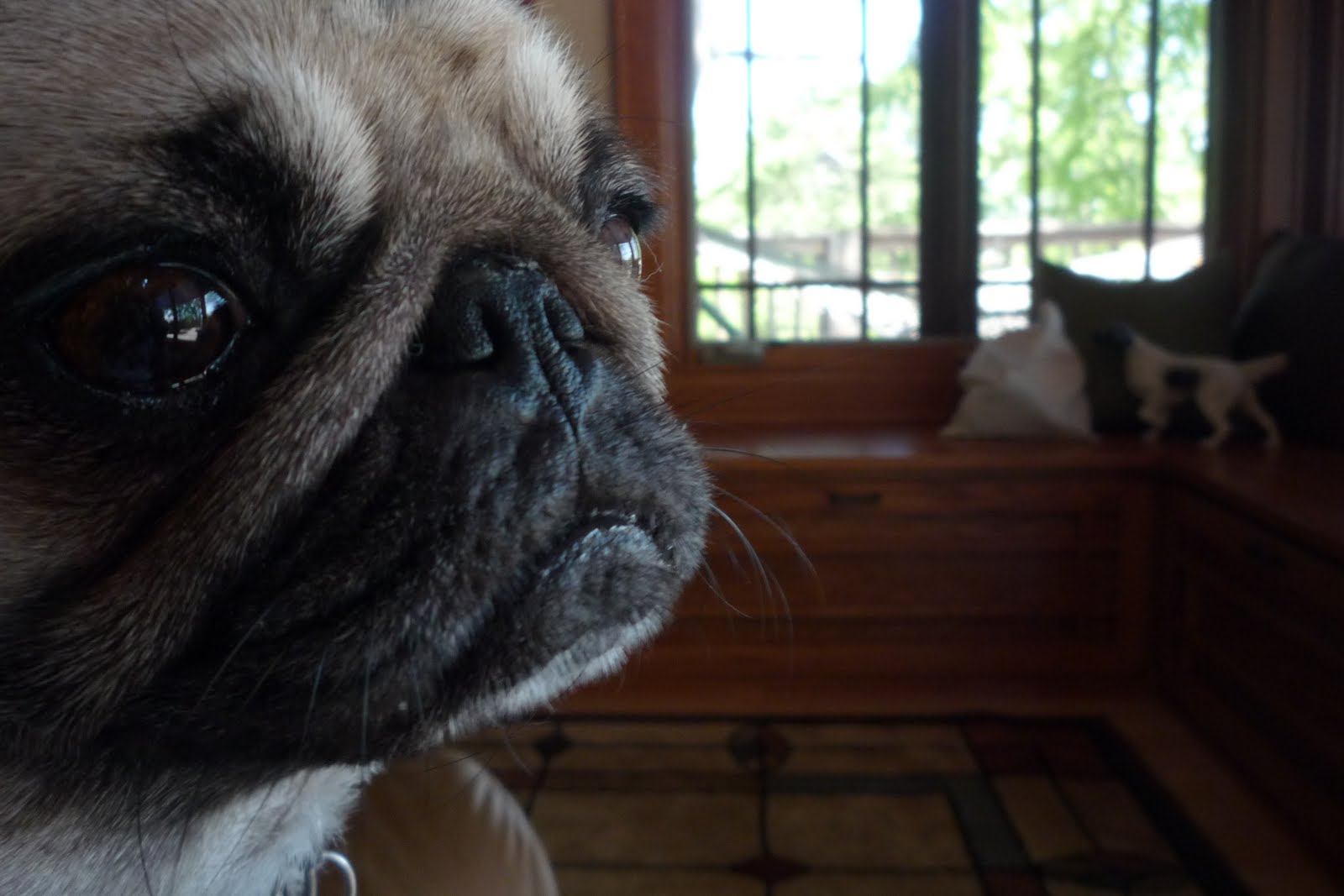
I was going home to Iowa to pick up baby pug, who had been staying at my parents' house while I was on vacation in France. This is, of course, a completely fair trade: Iowa for France.

It's fair when one of you is a pug.

I was worried that Miss Daisy might a1a) not remember me, or b2b) be mad at me for leaving her in Iowa while I gallivanted off to the land of pastries and good butter. {I don't know if pugs have discerning enough tastebuds to know good butter, but in my mind, she was going to be mad at me about the butter, not about the abandonment thing.}

I called my mama the other night to check on baby pug. They had just gotten home from vacation—

Yes, they were on vacation, too. You're probably wondering, "Did you leave Miss Daisy to fend for herself? Perhaps by using her little pug legs and jumping up to eat the ears of elephant's-eye-high corn?"

And to that I say, "Now that's just ridiculous. First of all, my parents live in town where there are no cornfields. Second of all, I'm sure their two pugs would help her out and they could build a pug pyramid to get the corn, should they find any stalks in town, which, as mentioned before, is unlikely."

My parents have a pug sitter from the vet come to stay with their puggies when they go on vacation, so I figured that Miss Daisy would be in good hands. Perhaps more capable hands than my hands. I pretty much figured it'd be like a pug spa for Miss Daisy.

So I called my mama to check on baby pug, and she said, "Do you want to talk to her?"

Now, I may be one to think that my pug is going to be mad at me for butter.

And I may talk to her out loud while we're on walks.

And I may try to explain to her why she can't bark at every little noise, using all my powers of logic and expression.

Doing all of that is one thing; talking to your pug on the phone is another thing entirely.

It wasn't much of conversation. Obviously. She mostly tried to breathe as a form of communication.

My mama said she licked the phone, which cemented in my mind a reason why you should never let a pug talk on the phone, besides the fact that pugs can't talk to begin with.

But now Miss Daisy and I are reunited and yes, it feels so good.

When we got home to Glen Ellyn yesterday, she ran to every corner in the apartment, making sure it was just as she remembered.

My bed! My food bowl! My toys! My treats!

And yes, I am, once again, projecting emotions on to Miss Daisy.

You see, that's how I feel when I come home, whether I've been gone a weekend or a week.

Of course, I don't get excited about my food bowl, mostly because I have multiple food bowls that I call "dishes," but I do have this overwhelming sense of relief when I step inside my apartment.

My bed! My books! My multiple DVDs of The Mary Tyler Moore Show! My flowers! My time!

I may not run around and sniff everything—even though I live alone, even I know that would be weird—but I do smile as I settle into my reading nook to catch up on the newspaper.

And that is exactly what Miss Daisy did in her own pug way: after calming down, she went straight for her favorite spot on the couch, circled around 10 times, then plopped down with a pug smile.

She was home. And it feels so good to have a place, a space to call home, where you know you belong.

02 April 2011

a change in perspective


Today, I needed a change in perspective and so I re-arranged my bedroom.

I've heard it said that paint is the cheapest way to redecorate, but you know, just by moving around some furniture, you can feel like you're in a new place, a new room, a new room.

You can get a change in perspective just by moving your bed.

I thought of this in the midst of a 9-mile run this morning. I spent several miles re-arranging my bedroom in my head. Would the bed be better against that wall? Would the dresser fit there? What about the artwork?

Running is useful for all kinds of things, including physical fitness and a sense of accomplishment.

But I also use it as rambling thinking time.

Under other circumstances, I wouldn't allow myself 30 minutes to imagine moving furniture.

On a sunny Saturday morning, though, a few miles into a long-ish run and completely music-less {Lent and its lack of distraction apply even on the running path}, I let my mind wander over art options and so when I got to the end of my run, I knew exactly what I wanted to do.

And somehow, my body wasn't tired enough from running, so I had the energy to move my bed. By myself. I thought of it as weight lifting to accompany my cardio exercise.

I will say: moving my bed and vacuuming was more fun than reps at the gym. If I keep this up, I could have constantly re-arranging furniture {new perspectives all the time!}; a home scrubbed so clean, there's no paint on the walls or sheen to the hardwood floor; and amazing arm muscles.

I am content with my change in perspective. The whole point of this was to make it possible for me to look out the window first thing in the morning. Without even getting out of bed, I can see the just-growing-light sky and the just-budding trees.

I can see my day before I even set foot on the ground, and I can say, "Thank you, Lord, for this day."


A chair for reading. Shoes for running.
And a curly pug tail because Miss Daisy wouldn't stay out of my picture.


A good good morning view.


30 March 2011

remembrance of things past: french nostalgia


As I wrote earlier this week, I've been getting a little nostalgic for France, as I normally do in the spring, possibly because of that song "April in Paris."

Or it's possibly because after months of feeling out of place in France {when I lived in Normandy 6 years ago}, spring is when I finally started to feel at home.

So this is a remembrance of things past kind of post {with a nod to Proust, of course}: here is something I wrote about the smell of France when I was living in Normandy.

I wrote this for my hometown newspaper, The Hawk Eye, which was publishing occasional columns from me about my life in France (with a nod to Julia Child there}.

You know you're from a small town when you can get a column in the newspaper just for going somewhere else. {And to this day in Burlington, people will reference me as "that French girl."}

In this column, I wanted my Iowans to be able to breathe in France, just as I was. I also wanted them to take a deep breath of Iowa and appreciate where they were.

{A good note before you read this: I lived in France twice. My junior year, I studied abroad in Aix-en-Provence, so when I talk about my French life before or what my life was like after coming back to America—well, I'm talking about that period in between Aix and moving back to France after college.}

-----

I’d forgotten the smell of France after going back to America. I forgot a lot of tiny details of my French life when I returned to the Midwest, small everyday nothings that together created days of everything.

I think that I let so much of my French life slip through my mind because back in America, my normal, expected, and loud life pushed away the inconspicuous pieces of France.

I remembered my idealized chunks—mostly based on the vague notion of a better way of life that seems to lengthen every minute of every day until they melt into each other.

In my memory of France, there was little room for realistic details; I painted a large canvas quickly, catching the light and colors like an Impressionist. I smudged over the deceivingly mundane, so my picture of France comes out somewhat like a Renoir.

The faces are animated, full of life and accuracy, but the food and drinks on the table are blurs of color and short strokes. You know there’s a croissant and maybe a cup of café noir, though, in the same way that I knew vaguely that the forgotten details of my French life—the details that had sustained me—had been real and solid.

I felt that there were details, like the exact sound of French sirens and what fromage blanc tastes like with three scoops of sugar in it, but they were only sketched in short strokes as the immenseness of American life marched over them.

But the smell of France...it’s come back to me.

25 November 2010

callahan family orange rolls


Orange rolls. If there aren't orange rolls somewhere in the buffet line-up at Thanksgiving, my family's holiday is a little less Norman Rockwell and a lot more whiny. {Although you know that in that Rockwell image, a little kid is kicking his sister under the table. Nothing is as it seems, especially in iconic images of americana perfection.}

We've always had orange rolls in the Callahan family. Always have and always will, if I have anything to do with it, which I do, seeing as I'm in the family and of my sister and me, I'm the one who likes to cook.

My great-grandma used to make them, back when she hosted Thanksgiving at her house in Albia, Iowa. That's when my mom was little, and then she grew up into the one who hosts Thanksgiving every year.

With the hosting responsibility came the privilege of making the family orange rolls, and like the methodical person she is, my mom asked my great-grandma to write down the recipe.

Up until that point, it was one of those "in the head" recipes that great-grandmas are known for. She didn't need a recipe card for this and made it seem that she had been born with the knowledge of the proportions of salt, sugar, shortening, and flour. {Why was I not born with that knowledge? Do I not have some of her genes?}

My great-grandma was, I must remember, part of that generation who cooked three meals a day, day after day, for years on end—not to make it sound monotonous, but just to point out that cooking was second nature. It wasn't something she pulled out on special occasions.

Great-grandma did write it down, but my mom spent the next several years asking clarifying questions.

"Grandma, you said that the oven should be at 400, but my rolls just burn at 400."

"I never said 400!" my grandma answered, quite contrary to what her own handwriting said. "I always put the oven at 375."

One of the most perplexing instructions in the recipe is: "Keep adding flour until the proper texture."

My mom, try as she may, could not get my great-grandma to explain that better.

"Well," she would say, "I just keep going until it feels right."

Ah, until it feels right. That really clears things up. The word "proper" was what was confusing.

With every new insight she got, my mom made notes on the original handwritten recipe, and it's becoming something of a family heirloom—in my eyes, anyway.

There's my great-grandma's spidery handwriting, complete with extra-loopy L's that make you yearn for times when handwritten letters were the norm.

In little asides, there's my mother's straightforward handwriting, hints of how to get these to turn out right so that Thanksgiving always tastes like it did when she was little. And like it did when I was little.

I've started to learn how to make the Callahan family orange rolls, so I fully expect that one day, I'll get the handwritten recipe to add my own notes to.

Actually, I've already started adding: in the recipe below, the bold additions are my mother's notes. {You can see, then, that my great-grandma actually left out the instruction to let the rolls rise, then punch them down and roll them out. Perhaps, to her, that was just so obvious. Of course the rolls would rise. Of course you'd punch them down. How else do you expect to make bread?}

The bold and italicized notes are me because when I'm learning, I'm an every-step-spelled-out girl, and I'll need to do this a few more times to get all my orange roll steps outlined thoroughly enough for even me.

And then one day, these orange rolls will be second nature to me, just as they were to my great-grandma. I hope.


ingredients

  • 2 packages yeast
  • 1/2 cup lukewarm water
  • 2 eggs
  • 1/2 cup shortening
  • 1 1/2 cups milk
  • 2 teaspoons salt
  • 1/2 cup sugar
  • 6 to 7 cups flour
for the glaze

  • 2 cups powdered sugar
  • 3 tablespoons butter
  • rind and juice from one orange

directions
  1. Dissolve the yeast in the water that is heated to 110 to 115. Let set while you do the basic recipe.
  2. Beat the eggs, then add the shortening, salt, and sugar.
  3. Put in the milk that is heated to luke warm {same temp as water}.
  4. Add 2 cups flour and beat well.
  5. Add the yeast and beat again {beat real good}.
  6. Keep adding flour until the proper texture.
  7. Knead.
  8. Let rise, punch down, and roll out.
  9. Brush with butter, sugar, and orange rind, and then roll up.
  10. Cut into 1 1/2 inch slices and arrange rolls in buttered and floured 9x13 pan.
  11. Bake at 400 {my mother has crossed this out and corrected it to 375} for 15 minutes {my mother says really, it's 12-15 minutes}.
  12. Before serving, heat the rolls and then add the glaze.

15 November 2010

sunday evening


Sunday evenings have always been my favorite time of the week. I wasn't one of those kids who dreaded going back to school come Monday morning, and even now, I don't get those Sunday evening doldrums about Monday morning back in the office—most of the time, I should admit.

I've always viewed Sunday evenings as a chance to gear up for the week, to think ahead to what's good, what's challenging, what's motivating {and what I'll need some extra motivation to get through}.

Sunday evening is a pause before busyness; all of Sunday should be a pause before busyness, in my view.

Sunday should be long walks. Or big cups of tea, if that's your thing.

It should be writing cards or folding clothes—just little things to check off your to-do list. Not such big tasks that they're overwhelming; Sundays are not for vacuuming the baseboards.

It should be the time you get to read the whole newspaper, not just a few stories here and there. It is, by the way, okay to start by reading the comics.

And it should be the time you let yourself watch a favorite old movie while eating popcorn and wearing your flannel pj pants {that you changed into at 7pm}.

Or confession of what I did last night: I watched a Disney movie. Not like old school Disney Beauty and the Beast, but new school Disney, the teeny bopper kind that is set in a perfect small town, one most likely in California. I know that those things are made for 12-year-olds who have no idea of what high school is like, but I—even knowing that people in high school don't fall into such clear-cut roles—get drawn to those things like underclassmen girls to the quarterback.

And related confession: I looked up the movie online today and saw that it's based on a book by Meg Cabot. You know, the lady who wrote The Princess Diaries. Oh, you didn't know that? Well, now you do. It's good to keep up on young adult lit. Then you know what the kids are talking about. Unless they use all that text-y language. Then no one knows what they're talking about.

Also, I'm headed to the library after work to get said book that was made into a Disney movie. I need a little light reading in my life.

But back to Sunday evenings: in my house growing up, Sunday evening was pizza night, which may also be playing into my perpetual Sunday evening excitement, even if I don't have pizza night any more. {Note to self: order pizza next Sunday night.}

Sunday, to me, always has been and always will be cozy family. All of us were home then, and even if we were all doing different things—homework, paying bills, playing chess—we were all there. In one house. And ready to run to the door when the pizza man came.

DH Lawrence's poem "Piano" captures my Sunday evening coziness. When I read this poem, I'm reminded of how good literature can take you somewhere else, perhaps somewhere the writer never intended you to go.

I read this poem, ostensibly about a piano and a mother and a grown man, and I don't see the image that Lawrence is painting; my own emotional picture is in the way.

I read his line "till the heart of me weeps to belong / To the old Sunday evenings at home" and I see my sister and me playing games on our old blue-screened, very early computer. I see me doing homework at the kitchen table, and I see a family game of Parcheesi or Hearts.

I like how literature can do that—how DH Lawrence {of all people; I've never cared much for him} can give me an emotional snap and reminder of why I love Sunday evenings.

piano
dh lawrence

Softly, in the dusk, a woman is singing to me;
Taking me back down the vista of years, till I see
A child sitting under the piano, in the boom of the tingling strings
And pressing the small, poised feet of a mother who smiles as she sings.

In spite of myself, the insidious mastery of song
Betrays me back, till the heart of me weeps to belong
To the old Sunday evenings at home, with winter outside
And hymns in the cosy parlour, the tinkling piano our guide.

So now it is vain for the singer to burst into clamour
With the great black piano appassionato. The glamour
Of childish days is upon me, my manhood is cast
Down in the flood of remembrance, I weep like a child for the past.


29 May 2010

you can go home again


and when you get home, you can take pictures of it.
and then later, 
when you aren't so tired, 
you can write more about home.
what is it about being home 
that makes my entire body 
collapse in on itself
and beg for more time
sleeping in
the bedroom that still has 
the pink carpet 
i picked when i was 6?


the morning walk along the Mississippi.  
{Yes, that's a pug in the stroller.  He's old and can't walk well, ok?}


recovery from the morning walk


downtown burlington and the snake alley criterium


{snake alley is the crookedest street in the world.}

{and every year, there's a bike race on 
the Saturday of Memorial Day weekend:  
the Snake Alley Criterium.}


LinkWithin

Related Posts with Thumbnails